Book Resources for Professionals
Most books available on Amazon or online book store unless otherwise noted.
To help support Hope After Brain Injury, we use an affiliate link that provides us with a small percentage of the sale total.
Christian and Faith-based Counseling for Brain Injury
Techniques for Survivors and Families
By Deana Adams
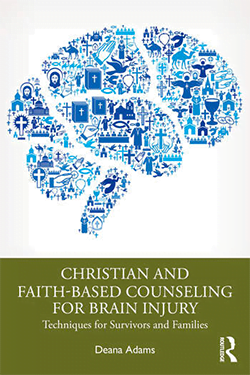 Christian and Faith-based Counseling for Brain Injury is the first book of its kind to offer faith-based therapy to address the emotional, cognitive, and mental health needs of individuals who have suffered a traumatic brain injury (TBI). A highly researched piece of work, the book puts forth an innovative and effective method for not only addressing the challenges of a life-changing injury but also for creating a sense of purpose.
This book is valuable reading for all individuals invested in providing support to the TBI community. It is aimed at counselors, lay counselors, healthcare professionals, social workers, psychotherapists, seminary students, and upper-level graduate students. It will further be of use to for clinicians working in the outpatient level of care and private practice settings.
Confronting Traumatic Brain Injury: Devastation, Hope, and Healing
By William Winslade
William Winslade presents facts about traumatic brain injury; information about its financial and emotional costs to individuals, families, and society; and key ethical and policy issues. He illustrates each aspect with dramatic case studies, including his own childhood brain injury. He explains how the brain works and how severe injuries affect it, both immediately and over the long term, pointing out how resources are often squandered on patients with poor prognoses but adequate insurance, while underinsured patients with better prognoses often do not receive the best care. He describes the lack of regulation in the rehabilitation industry and what federal and state legislatures are doing to correct the situation. And he recommends policy changes for lowering the instances of traumatic brain injury (such as raising the minimum driving age) as well as practical steps that individuals can take to protect themselves from brain trauma.
Effective Psychotherapy for Individuals with Brain Injury
By Ronald Ruff and Serana Chester

Combining scientific expertise with psychotherapeutic acumen, this book is highly accessible and packed with clinical tools. Part I provides essential information on how acquired brain injury affects emotional functioning. Part II describes practical, specially tailored ways to treat anxiety, depression, and anger related to brain damage, and to help patients regain a sense of meaning and value in their lives. The book shows how standard psychotherapeutic interventions can be adapted for the brain-injured population, as well as which approaches may be contraindicated. It presents a biopsychosocial framework for assessment and treatment that integrates emotional support, cognitive-behavioral techniques, and acceptance- and mindfulness-based strategies.
Psychotherapy after Brain Injury: Principles and Techniques
by Pamela S. Klonoff
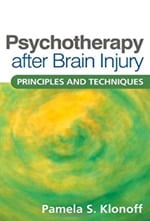
This book presents hands-on tools for addressing the multiple ways that brain injury can affect psychological functioning and well-being. The author is a leader in the field who translates her extensive clinical experience into clear-cut yet flexible guidelines that therapists can adapt for different challenges and settings. With a focus on facilitating awareness, coping, competence, adjustment, and community reintegration, the book features helpful case examples and reproducible handouts and forms. It shows how to weave together individual psychotherapy, cognitive retraining, group and family work, psychoeducation, and life skills training, and how to build and maintain a collaborative therapeutic relationship.
Traumatic Brain Injury: Rehabilitation for Everyday Adaptive Living, 2nd Edition
by Jennie Ponsford, Sue Sloan, and Pamela Snow

Its uniquely clinical focus provides both comprehensive background information, and practical strategies for dealing with common problems with thinking, memory, communication, behaviour and emotional adjustment in both adults and children. The book addresses a wide range of challenges, from those which begin with impairment of consciousness, to those occurring for many years after injury, and presents strategies for maximising participation in all aspects of community life.